

Newfoundland Dog: Size, Temperament, Care and UK Owner’s Guide
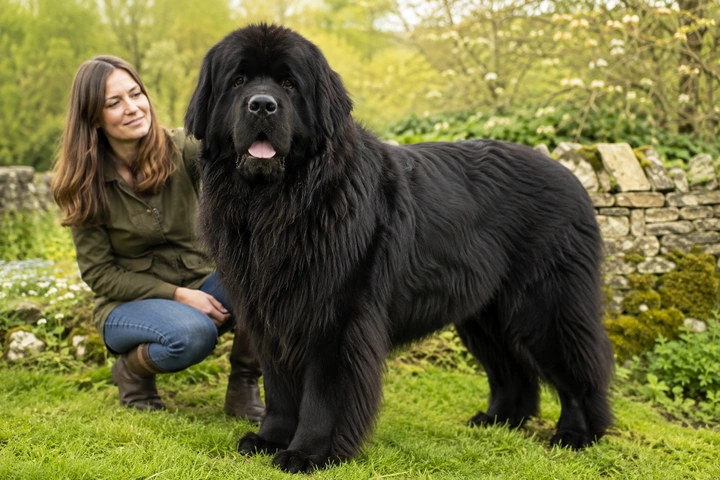
The Newfoundland Dog is difficult to ignore. Huge paws, a bear-like coat and a face that somehow manages to look both majestic and mildly concerned about whether you have enough snacks. But behind that impressive size is a breed known for its gentle, patient nature and long history as a working water dog.
For prospective UK owners, though, falling for the fluffy exterior is the easy bit. Living with a Newfoundland means making room for a very large dog, regular grooming, considerable food bills, muddy paws, drool and some important health considerations. This guide covers Newfoundland dog size, weight, temperament, lifespan, puppy buying, costs and everyday care so you can decide whether this particular gentle giant really fits your household.
Read also: Dog Breeds Guide UK Owners Actually Need
Newfoundland Dog at a Glance
The Newfoundland originated as a working dog associated with Newfoundland in Canada, where its strength, water-resistant coat and swimming ability made it useful around fishing communities. Today, the Royal Kennel Club places the breed in the Working group and describes it as a powerful, versatile water dog that has become a gentle and loyal family companion.
| Trait | Newfoundland Dog |
|---|---|
| Breed group | Working |
| Average male height | Around 71 cm at the shoulder |
| Average female height | Around 66 cm at the shoulder |
| Average male weight | Around 64–69 kg |
| Average female weight | Around 50–54.5 kg |
| Coat | Dense, medium-length double coat |
| Recognised colours | Black, brown and Landseer |
| Exercise | Around one hour daily for a healthy adult |
| Grooming | Daily |
| Typical lifespan | Under 10 years |
| General temperament | Gentle, patient, devoted and docile |
The Royal Kennel Club figures are breed-standard averages rather than targets every individual must hit, so a healthy dog may naturally be slightly larger or smaller.
Newfoundland Dog Size, Weight and Appearance
How Big Is a Full Grown Newfoundland Dog?
Very big. There is no cleverer way of putting it.
A full grown Newfoundland Dog is one of those breeds that can make an ordinary Labrador suddenly look rather compact. The Royal Kennel Club gives an average shoulder height of about 71 cm for males and 66 cm for females. Adult males average approximately 64–69 kg, while females average around 50–54.5 kg.
If you have only seen photographs, seeing a Newfoundland dog next to a human gives a much clearer impression of the breed’s scale. They are not exceptionally tall in the way some giant breeds are, but their deep body, substantial bone, broad head and thick coat give them enormous presence.
That size has practical consequences. Before bringing one home, think beyond whether the dog technically fits through the front door. You’ll need space for:
- A genuinely large dog bed
- Food and water bowls that won’t become trip hazards
- Safe room in the car
- Grooming equipment
- Comfortable areas away from radiators and direct summer sun
- Enough floor space for a giant dog to stretch out without blocking the entire kitchen
And yes, at some point your Newfie will probably choose to lie precisely where everyone needs to walk.
Newfoundland Dog Weight: Bigger Is Not Always Better
A heavy breed should not automatically be encouraged to become heavier.
Your dog’s ideal weight depends on sex, frame, age, body condition and individual development. The breed-standard averages give owners a useful reference point, but your vet is better placed to assess whether an individual dog is carrying an appropriate amount of body fat and muscle. The Royal Kennel Club also recommends monitoring puppy growth rather than trying to push a young dog towards a particular adult weight.
Maintaining a healthy body condition matters particularly in a breed where joints already carry considerable weight.
Black Newfoundland Dog, Brown or Landseer?
The classic black Newfoundland Dog is probably the image most people have in mind: an enormous black coat, broad head and slightly damp-looking expression.
Under the current Royal Kennel Club breed standard, the recognised colours are:
- Black
- Brown
- Landseer, meaning predominantly white with black markings
The coat itself is double-layered, dense and water resistant, reflecting the Newfoundland’s development as a working water dog.
Colour should never be a more important consideration than health, temperament or responsible breeding. The Royal Kennel Club specifically advises puppy buyers to prioritise health and temperament over coat colour.
Newfoundland Dog Temperament: Is This Giant Really So Gentle?
The Newfoundland dog temperament is one of the breed’s biggest attractions. The Royal Kennel Club describes the ideal temperament as exceptionally gentle and docile, while PDSA characterises Newfoundlands as calm, good-natured dogs.
That doesn’t mean every Newfoundland arrives pre-programmed as a perfectly behaved teddy bear.
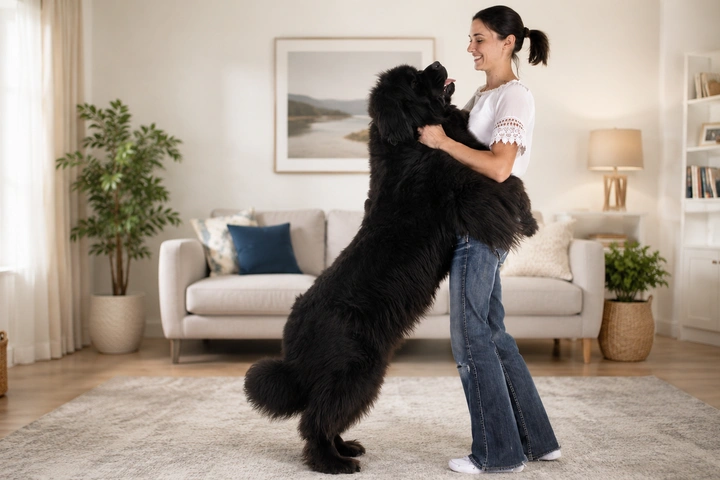
A 60 kg dog that hasn’t learnt polite greetings can still knock somebody over enthusiastically. Early socialisation and consistent training matter enormously because behaviours that seem funny in a 10-week-old Newfoundland dog puppy become considerably less charming once that puppy has grown into a small sofa with legs.
Newfoundlands With Children and Other Pets
Their generally patient nature can make well-socialised Newfoundlands appealing family companions, but size changes the equation.
A friendly adult could accidentally knock over a toddler, while an excited puppy may play more physically than intended. Children and dogs should therefore be supervised together, regardless of how gentle the breed is.
Teach children not to climb on the dog, disturb it while eating or sleeping, grab its fur or assume that patience means unlimited tolerance.
With other dogs and household animals, thoughtful introductions and early socialisation are more useful than relying on breed reputation alone. Every dog’s personality and previous experience matters.
Read also : Introducing Dogs Safely
Training a Newfoundland Dog
Start early.
Newfoundlands are powerful enough that basic manners are not optional. Useful priorities include:
- Walking without pulling
- Coming when called
- Waiting calmly at doors
- Keeping four paws on the floor when greeting people
- Settling quietly
- Accepting grooming and veterinary handling
Reward-based training works well and is recommended by PDSA for the breed.
Short, enjoyable sessions tend to be more productive than turning training into a battle of wills.
Read also : How to Stop a Dog Pulling on the Lead
Exercise and Everyday Life With a Newfoundland
How Much Exercise Does a Newfoundland Need?
For a healthy adult, the Royal Kennel Club and PDSA both indicate roughly one hour of exercise per day as a general guide. Newfoundlands are historically working dogs and many enjoy swimming, walking and activities that allow them to use their strength without endless high-impact running.
That hour does not have to mean one relentless march around the neighbourhood.
A sensible routine might combine walks with sniffing, training, gentle play and mental enrichment.
Puppies are different. Their bones and joints are still developing, so PDSA advises against over-exercising young Newfoundlands. Your breeder and vet can help you adjust exercise appropriately as your puppy grows.
Swimming and Water
The breed’s association with water is not merely decorative. The Newfoundland was developed for work involving boats, fishing equipment and water rescue, and its dense water-resistant coat and webbing between the toes reflect that history.
Some individual Newfoundlands adore swimming; others may be less enthusiastic.
Never assume instinct makes a dog automatically safe around rivers, reservoirs or the sea. Strong currents, cold water, algae, steep banks and difficult exits can be dangerous even for powerful swimmers.
Grooming a Newfoundland Without Losing Your Entire Weekend
The answer to “Does a Newfoundland shed?” is a confident yes.
The Royal Kennel Club lists daily grooming for the breed, while PDSA notes that grooming becomes particularly important during periods of heavier shedding.
Coat Care
The double coat needs regular attention to prevent tangles and remove dead hair. Concentrate especially on areas where friction encourages matting, including:
- Behind the ears
- Under the front legs
- Around the chest
- The back legs
- Around the tail
Get a Newfoundland dog puppy comfortable with brushes, combs, paw handling and body checks from an early age. It is substantially easier to teach grooming manners while you can still persuade the puppy to move without hiring a forklift.
Regularly check ears, nails, skin and paws as part of the routine, and contact your vet if you notice persistent itching, soreness, unusual lumps, discharge or other changes.
And Then There’s the Drool
Many Newfoundlands drool, and PDSA also warns prospective owners that they can be messy drinkers.
This is worth knowing before purchase rather than discovering it shortly after repainting the hallway.
Keeping washable cloths nearby, using easy-clean flooring around water bowls and wiping the dog’s mouth when necessary can make daily life easier.
Sudden or unusually heavy drooling is different from a dog’s normal slobber. If it appears alongside distress, abdominal swelling, repeated retching or other worrying symptoms, contact a vet urgently because excessive drooling can occur with serious conditions such as gastric dilatation-volvulus.
Newfoundland Dog Lifespan and Health
The Newfoundland dog lifespan is an important consideration before committing to the breed. Both the Royal Kennel Club and PDSA currently list the typical lifespan as under 10 years.
No lifespan figure predicts how long an individual dog will live. Genetics, general health, body condition, veterinary care and simple chance all play a part.
Health Problems Prospective Owners Should Understand
PDSA lists several potential health concerns in Newfoundlands, including hip dysplasia, elbow dysplasia, gastric dilatation-volvulus or GDV, heart problems, osteosarcoma, hypothyroidism and some inflammatory or allergic conditions.
This does not mean your Newfoundland will develop these illnesses. It does mean health screening deserves serious attention when selecting a breeder.
The Royal Kennel Club currently recommends pre-breeding testing that includes:
- DNA testing for cystinuria
- BVA/KC elbow testing
- BVA/KC hip testing
- Eye testing as part of its additional best-practice recommendations
Ask a breeder to show you the actual results rather than simply saying that the parents are “vet checked”. A routine health examination and breed-specific screening are not the same thing.
Know the Signs of GDV
Gastric dilatation-volvulus, commonly called GDV or a twisted stomach, is a life-threatening emergency seen particularly in large, deep-chested dogs. PDSA identifies Newfoundlands as one of the breeds potentially affected.
Warning signs can include repeated unsuccessful attempts to vomit, restlessness, abdominal swelling and obvious discomfort. A swollen abdomen is not always obvious at first.
If you suspect GDV, contact a vet immediately rather than waiting to see whether it improves.
This article provides general information only and cannot replace individual veterinary advice.
Newfoundland Dog Puppy: What Prospective UK Owners Should Know

Searching for a Newfoundland dog for sale can be exciting. It is also the point at which sensible people sometimes temporarily lose all critical thinking because somebody has placed a fluffy puppy in their lap.
Try to resist.
Step-by-Step: Finding a Newfoundland Dog for Sale UK
If you’re looking for a Newfoundland dog for sale UK breeders and rehoming organisations should be researched carefully rather than chosen purely because a puppy is immediately available.
A sensible process is:
- Research the adult breed first.
Make sure you want the 60 kg adult, not merely the adorable puppy. - Contact established breed clubs or recognised breeder directories.
The Royal Kennel Club provides breed-club information and a Find a Puppy service. - Ask which health tests have been completed.
Request evidence for relevant hip, elbow, cystinuria and other recommended screening. - Meet the puppy and breeder properly.
Look at the dogs’ living conditions and discuss temperament, feeding, health and socialisation. - Meet the mother where appropriate.
Be cautious about elaborate excuses explaining why this is impossible. - Expect questions from a responsible breeder.
Somebody who cares where their puppies go should want to know about your household, work routine and experience. - Walk away from pressure.
“Pay the deposit in the next 20 minutes or you’ll lose the puppy” is not a compelling reason to rush a decade-long commitment.
Read also : Complete Puppy Care Guide
Newfoundland Dog Price: Think Beyond the Purchase Cost
Searches for Newfoundland dog price often focus entirely on how much the puppy costs.
That is only the starting point.
Puppy prices can vary substantially according to breeder, location, pedigree, availability and other factors, so quoting a single UK purchase figure quickly becomes misleading. More importantly, buying cheaply from a poor source may expose both dog and owner to much larger welfare and veterinary problems later.
PDSA currently estimates a minimum monthly cost of £105 for caring for a Newfoundland, while making clear that this does not include veterinary treatment for illness or injury.
For a dog this size, budget for:
- High-quality food
- Extra-large beds and equipment
- Routine veterinary care
- Preventative parasite treatment as advised by your vet
- Training
- Grooming equipment or professional grooming
- Insurance
- Boarding or pet-care costs
- Replacement leads, toys and beds
- Unexpected veterinary treatment
Large-dog costs have a habit of being large too. A Newfoundland doesn’t eat, travel or fit into equipment like a 6 kg terrier.
Read also: UK Pet Insurance Guide
Common Mistakes to Avoid
Choosing based on colour alone: A black Newfoundland dog may be your dream, but health and temperament matter considerably more.
Underestimating adult size: Always plan around the full grown Newfoundland dog rather than the puppy you bring home.
Skipping health-test paperwork: “The parents have never been ill” is not a substitute for appropriate screening.
Over-exercising puppies: Giant puppies need activity and socialisation, but excessive high-impact exercise while joints are developing is not helpful.
Leaving training until later: A pulling 12 kg puppy is inconvenient. A pulling 65 kg adult can tow you towards a squirrel with alarming efficiency.
Ignoring grooming requirements: This is not a wash-and-wear breed.
Important Considerations for UK Newfoundland Owners
Summer Heat Needs Extra Attention
Britain may not be famous for tropical weather, but UK heatwaves are increasingly something dog owners have to plan around.
Newfoundlands combine two factors PDSA identifies with greater heatstroke risk: they are a giant breed and have a thick coat.
During warm weather:
- Walk during cooler periods of the day
- Provide constant access to fresh water
- Make sure your dog has shade and a cool resting place
- Avoid strenuous exercise
- Keep the coat well groomed and free of mats
- Never leave a dog in a hot vehicle
Heavy panting, excessive drooling, weakness, confusion or collapse can indicate heatstroke. Treat suspected heatstroke as an emergency and contact a vet while beginning appropriate first aid.
Microchipping and Identification
UK dog owners should also make sure they understand the current identification requirements where they live. Government guidance requires dogs to be appropriately microchipped, and dogs in public places must still wear identification showing the owner’s required details rather than relying on the microchip alone.
Keep your microchip database details updated whenever you move house or change contact information.
Buying Puppies in England
For readers in England, Lucy’s Law bans commercial third-party sales of puppies and kittens under six months. Someone buying a puppy should purchase directly from the breeder or obtain the animal through an appropriate rehoming organisation rather than a third-party dealer.
Animal-sale and licensing requirements are not identical throughout every UK nation, so check the current government or local-authority guidance that applies where you live before purchasing.
A Newfoundland Dog can be a wonderful companion for the right household: gentle, imposing, affectionate and wonderfully difficult to overlook when stretched across the kitchen floor.
But this is not simply a bigger version of an average family dog. Newfoundland dog size affects almost everything, from food and transport to training, grooming, veterinary planning and the amount of space required at home.
If you’re considering a puppy, focus on responsible breeding and verified health screening rather than colour, availability or the cheapest price. Make sure you can comfortably manage the costs and practical realities of a full-grown giant before committing.
Get those basics right, and the reward can be rather special: a huge, patient companion with an impressive working heritage and enough fluff to make your hoover question its career choices.
Key takeaways
- * The **Newfoundland Dog** is a giant working breed known for its gentle, patient and affectionate temperament.
- * A **full-grown Newfoundland Dog** can weigh around 50–69 kg, so owners need plenty of space and must prioritise early training.
- * Newfoundlands have a dense double coat that requires **frequent grooming** and they are known for shedding and drooling.
- * Healthy adults generally need around **one hour of daily exercise**, while puppies should avoid excessive high-impact activity as they grow.
- * The typical **Newfoundland Dog lifespan is under 10 years**, and the breed can be prone to joint, heart and other health problems.
- * UK buyers should choose a responsible breeder who provides evidence of appropriate **hip, elbow and cystinuria health testing**.
- * The initial **Newfoundland Dog price** is only part of the expense; food, insurance, grooming, equipment and veterinary care can make this a costly breed to own.
- * Their size and thick coat mean owners should take extra care during **warm UK weather** and watch carefully for signs of overheating.
- * A Newfoundland can be a wonderful family companion, but prospective owners should be ready for the practical realities of living with a very large, powerful and furry dog.
Frequently asked questions
A well-bred, appropriately socialised Newfoundland can make a gentle and devoted family companion. The breed standard emphasises a docile temperament. However, its sheer size means interactions with young children should still be supervised, and early training is essential.
Royal Kennel Club averages put males at around 71 cm tall and 64–69 kg, while females average about 66 cm and 50–54.5 kg. Individual dogs can fall outside these averages while remaining healthy.
The Royal Kennel Club and PDSA list the breed's typical lifespan as under 10 years. Individual lifespan varies, so this should be treated as a general breed guide rather than a prediction for a particular dog.
A healthy adult generally needs around one hour of exercise each day. Puppies should not be over-exercised while their bones and joints are developing. Swimming, walking and mentally engaging activities can suit the breed well.
Many do. PDSA notes that Newfoundlands tend to drool and can also be messy drinkers. If drooling suddenly becomes much heavier than normal or appears alongside retching, abdominal swelling or distress, contact your vet urgently.
There is no reliable single purchase price because breeder, location, pedigree, health screening and availability all influence asking prices. Look beyond the initial purchase cost: PDSA currently estimates minimum routine ownership costs for a Newfoundland at around £105 per month, excluding illness or injury treatment.