
All Birds: Names, Types and a Guide to Identifying Them
Trying to identify a bird in your garden, on a countryside walk or beside a pond? This guide to all birds introduces familiar species, explains the main types of birds and shows you what to look for when identifying them. From the red-breasted robin to the graceful swan, birds come in an astonishing variety of shapes, colours and sizes. A complete list of every bird species in the world would be enormous, so this guide focuses on well-known birds, including many commonly seen in the UK. You’ll find bird names, simple identification clues and tips for finding all birds’ names and images through reliable birdwatching resources. You don’t need expensive equipment to get started — just a little patience, a curious eye and perhaps a pair of binoculars.
What Are the Different Types of Birds?
Birds are warm-blooded animals with feathers, beaks and wings. Most species can fly, although some, such as penguins and ostriches, are flightless. Birds live in almost every kind of habitat, from British gardens and wetlands to tropical forests, deserts and the open ocean.
There are many ways to group birds. For beginners, grouping them by where they live or how they behave is a useful starting point.
Garden birds
Garden birds are the species you may spot from your kitchen window, on a bird feeder or in a local park. Many are small, familiar and relatively easy to recognise.
Some common UK garden birds include:
- Robin: Recognisable by its orange-red breast and face.
- Blue tit: A small bird with a blue cap, white face and yellow underside.
- Great tit: Larger than a blue tit, with a black head and yellow belly.
- House sparrow: A small, brownish bird often seen in groups around buildings.
- Blackbird: The male is black with a yellow-orange bill; the female is mainly brown.
- Starling: Dark, glossy feathers that can shimmer green and purple in sunlight.
- Goldfinch: A colourful finch with a red face and bright yellow wing markings.
- Magpie: A black-and-white bird with a long tail and a blue-green sheen.
- Woodpigeon: A large grey pigeon with a pale patch on its neck.
- Dunnock: A shy, brown-grey bird often seen hopping around on the ground.
These are useful species to learn first because you may see them regularly without travelling far. The RSPB’s garden bird guides provide photographs and identification clues for many of these familiar visitors.
Birds of prey
Birds of prey, also called raptors, hunt other animals or feed on carrion. They often have hooked beaks, strong feet and sharp talons.
| Bird name | How to recognise it |
|---|---|
| Red kite | Reddish-brown body and a distinctive forked tail |
| Buzzard | Broad wings, rounded tail and a soaring flight |
| Peregrine falcon | Powerful, fast-flying falcon with pointed wings |
| Sparrowhawk | Short, rounded wings and a long tail |
| Barn owl | Pale heart-shaped face and light plumage |
| Golden eagle | Very large eagle with broad wings |
Some birds of prey are easier to spot in particular landscapes. Red kites and buzzards may be seen soaring over open countryside, while peregrine falcons can sometimes be spotted around cliffs and urban buildings.
Waterbirds
Waterbirds spend much of their time on or around lakes, rivers, ponds, marshes and coastal waters. Some swim, some wade through shallow water, and others dive to catch food.
| Bird name | How to recognise it |
|---|---|
| Mute swan | Large white bird with a long neck and orange bill |
| Mallard | A familiar duck; males have a green head |
| Canada goose | Large goose with a black head and neck and white cheek patch |
| Moorhen | Dark waterbird with a red-and-yellow bill |
| Coot | Dark bird with a distinctive white bill and forehead |
| Grey heron | Tall, long-legged bird with a long, pointed bill |
| Kingfisher | Small bird with bright blue and orange plumage |
| Little egret | White heron-like bird with a slim black bill |
Look around ponds, canals, reservoirs and coastal paths for these species. Keep a respectful distance, particularly when birds are nesting or caring for their young.
Seabirds and coastal birds
The UK’s coastline offers opportunities to see birds that spend much of their lives at sea or around beaches and cliffs.
Examples include:
- Herring gull: A large gull with grey wings, a white body and a yellow bill.
- Black-headed gull: A small gull that develops a dark chocolate-brown hood during the breeding season.
- Puffin: A compact seabird with a colourful bill during the breeding season.
- Gannet: A large, pale seabird with long pointed wings and a yellowish head.
- Cormorant: A dark waterbird often seen perched with its wings held out to dry.
- Oystercatcher: A striking black-and-white coastal bird with a long orange-red bill.
- Turnstone: A small shorebird often seen searching among stones and seaweed.
Some seabirds are seasonal visitors to particular areas, so the species you see can depend on the time of year and location.
Woodland and countryside birds
Woodlands, hedgerows, farmland and heathland support many birds that may be less familiar than garden visitors.
| Bird name | Identification clue |
|---|---|
| Great spotted woodpecker | Black-and-white markings, with red on parts of the body |
| Green woodpecker | Green plumage and a loud, distinctive call |
| Jay | Pinkish-brown body and a bright blue patch on the wing |
| Wren | Tiny, brown bird with a short, often cocked tail |
| Song thrush | Brown upperparts and dark spots on its pale breast |
| Chaffinch | Male has colourful plumage and white wing markings |
| Skylark | Brown, streaky bird known for singing while flying |
| Pheasant | Large ground-feeding bird; males are brightly coloured |
Listen as well as look. A woodpecker’s drumming, a skylark’s song or a wren’s surprisingly powerful voice can reveal a bird’s presence before you see it.
Exotic and flightless birds
Not every bird is built for flight, and not every species lives in Britain. Around the world, birds have adapted to an extraordinary range of environments.
- Ostrich: A very large flightless bird native to Africa.
- Emperor penguin: A large penguin species from Antarctica.
- Kākāpō: A rare, flightless parrot native to New Zealand.
- Emu: A large flightless bird native to Australia.
- Flamingo: A long-legged wading bird known for its pink colouring.
- Toucan: A tropical bird with a large, colourful bill.
- Peacock: The male peafowl, famous for its elaborate display feathers.
- Macaw: A large, colourful parrot from Central and South America.
These birds may be familiar from wildlife documentaries, books or visits to zoos and wildlife parks.
All Birds Names: A Handy List for Beginners
If you’re looking for a quick list of bird names, start with these familiar species. They are grouped by broad type to make them easier to browse.
Common UK birds
Robin, blue tit, great tit, coal tit, long-tailed tit, house sparrow, starling, blackbird, song thrush, dunnock, wren, goldfinch, greenfinch, chaffinch, magpie, jackdaw, rook, carrion crow, woodpigeon and collared dove.
Birds of prey
Red kite, buzzard, kestrel, sparrowhawk, peregrine falcon, barn owl, tawny owl, short-eared owl, golden eagle and white-tailed eagle.
Waterbirds
Mute swan, whooper swan, mallard, teal, moorhen, coot, grey heron, little egret, kingfisher, Canada goose and greylag goose.
Coastal birds
Herring gull, black-headed gull, puffin, gannet, cormorant, shag, oystercatcher, curlew, redshank, turnstone and fulmar.
Birds from around the world
Ostrich, emu, emperor penguin, flamingo, toucan, macaw, kookaburra, hummingbird, hornbill, peacock and kākāpō.
This is a selection, not a complete global checklist. Bird species are numerous, and names can vary by region. For a more extensive list, use a recognised field guide or a bird identification database.
All Birds Images with Names: How to Identify What You See
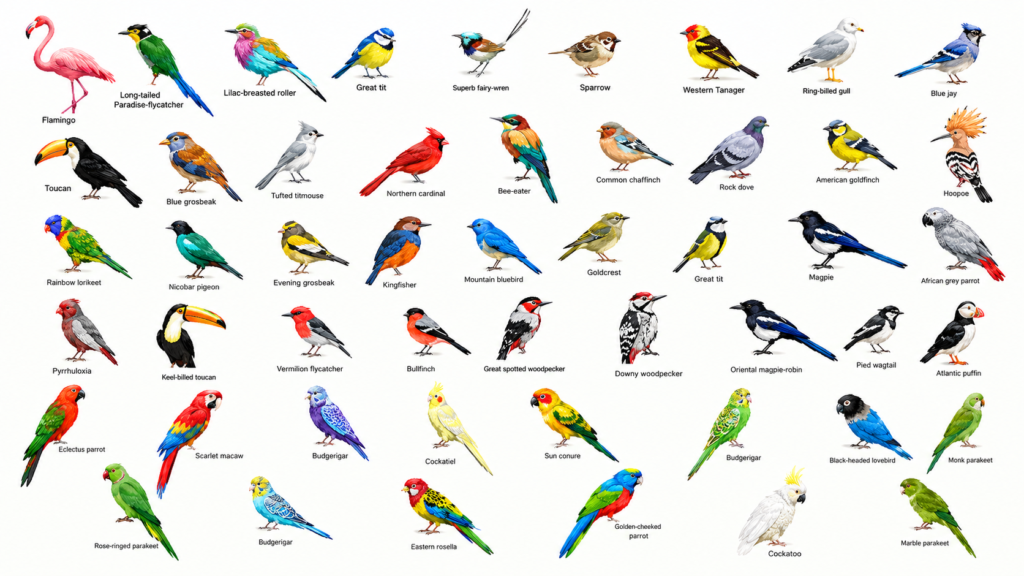
Photos can make bird identification much easier, especially when two species look similar. If you’re searching for all birds images with names, use a guide that pairs clear pictures with the bird’s name and distinguishing features.
The RSPB’s bird identification pages are a useful starting point for UK species. They include guides to common garden birds, birds of prey, gulls, swans and other groups.
When comparing bird images, look for more than colour. Lighting, age, season and the bird’s sex can change its appearance.
What to look for in a bird photo
Size and shape: Is the bird smaller than a sparrow, roughly blackbird-sized or as large as a pigeon? Notice the shape of its body, wings and tail.
Colour and markings: Look for a distinctive patch, stripe, cap, collar or breast colour. A robin’s orange-red breast is a helpful clue, while a magpie’s black-and-white pattern is unmistakable.
Beak shape: A short, strong beak may suit cracking seeds, while a long, slender bill may help a bird catch insects or probe mud.
Legs and feet: Long legs are common in wading birds. Webbed feet help many waterbirds swim.
Behaviour: Does the bird hop on the ground, cling to a feeder, dive into water or soar overhead?
Location and season: A bird’s habitat and the time of year can help narrow down the possibilities.
Where to find reliable bird pictures
- RSPB bird identification guides: Useful for common UK birds and their distinguishing features.
- RSPB garden bird guides: Helpful for identifying birds visiting gardens and balconies.
- A reputable field guide: A printed guide can be handy when you’re outdoors without a reliable internet connection.
- Local wildlife groups: Birdwatching groups may offer help identifying species seen in your area.
Avoid relying on a single photograph if you’re unsure. Compare several images and check the bird’s shape, markings and behaviour.
How to Identify a Bird in Your Garden
You don’t need to memorise hundreds of names. Start with a few simple observations and build your knowledge over time.
Step-by-step bird identification
- Watch from a distance. Use a window or a quiet spot outdoors so the bird can behave naturally.
- Estimate its size. Compare it with familiar birds, such as a sparrow, blackbird or pigeon.
- Notice its main colours. Look for clear markings rather than relying on the overall shade.
- Check the beak and tail. These can help distinguish similar-looking species.
- Listen to its call. Birdsong and calls can provide useful clues.
- Consider the habitat. A bird beside a pond may be easier to identify when you know which waterbirds live locally.
- Compare it with a trusted guide. Check the details before settling on a name.
If the bird flies away before you’ve identified it, don’t worry. It happens to everyone. Make a quick note of what you saw and check a guide afterwards.
Common bird identification mistakes
- Judging by colour alone: Light and weather can change how feathers appear.
- Forgetting that males and females may look different: Female blackbirds, for example, are brown rather than black.
- Ignoring young birds: Juveniles can look quite different from adults.
- Confusing similar species: House sparrows and dunnocks can be mistaken for one another at a glance.
- Getting too close: Chasing a bird for a better look can disturb it.
- Assuming every bird is a year-round resident: Some species migrate or appear only during particular seasons.
A little patience usually beats a frantic dash across the garden with binoculars.
Important Considerations for UK Pet Owners

Birdwatching can be a lovely activity for the whole household, including people who share their homes with cats and dogs. However, wild birds and pets need a little consideration.
Keep cats away from nests where possible
Cats are natural hunters, and birds may be especially vulnerable around nests and fledglings. If you have a cat that spends time outdoors, consider keeping it in during periods when young birds are active, particularly around dawn and dusk. A well-fitted collar with a suitable bell may help warn some birds, although it cannot prevent every catch.
Never punish a cat for hunting. Instead, focus on practical steps that reduce opportunities for it to approach birds.
Make your garden welcoming to birds
You can support visiting birds by providing suitable food, fresh water and places to shelter. Choose bird food appropriate for the species you hope to attract, keep feeders and bird baths clean, and position them where birds have a clear view of approaching danger.
Native plants, hedges and shrubs can provide food and cover. Avoid disturbing nests, and keep pets away from areas where birds are raising their young.
What if your pet catches a bird?
If your cat or dog catches a wild bird, keep your pet calm and separate them from it. If the bird is injured, contact a local wildlife rescue or a vet for advice. Avoid handling a wild bird unnecessarily, and do not attempt to treat serious injuries yourself.
If your pet has been bitten, scratched or seems unwell after contact with wildlife, contact your vet.
Read Also: Cat Care Guide
Read Also: Dog Safety Guide
Read Also: Cat Behaviour Guide
Final Thoughts
Learning about all birds can feel like a huge task, but you don’t need to know every species to enjoy the birds around you. Start with a handful of familiar names, learn their shapes and calls, and gradually add new birds to your list. For UK readers, garden birds are a brilliant place to begin. A robin on the fence, a blue tit at the feeder or a magpie striding across the lawn can turn an ordinary day into a small wildlife moment. Use reliable guides for all birds’ names and images, observe wildlife without disturbing it, and remember to keep cats and dogs safe around wild birds. Before long, you may find yourself identifying birds by their calls before you’ve even looked out of the window.
Key takeaways
- * Birds come in many shapes and sizes: From tiny wrens to large eagles and flightless ostriches, birds live in a wide range of habitats around the world.
- * Start with familiar UK garden birds: Robins, blue tits, blackbirds, house sparrows, goldfinches and magpies are great species for beginners to learn.
- * Birds can be grouped by habitat and behaviour: Common groups include garden birds, birds of prey, waterbirds, seabirds, woodland birds and flightless birds.
- * Learn bird names and identification clues: Look at a bird’s size, colour, beak, tail, markings, behaviour and habitat.
- * Use reliable bird images: The RSPB’s bird identification guides are useful for finding bird pictures, names and descriptions.
- * Remember that birds can look different: Age, sex, season and lighting can affect a bird’s appearance, so compare several identification clues.
- * You don’t need expensive equipment: Patience, careful observation and a simple field guide are enough to begin birdwatching.
- * Make your garden bird-friendly: Provide suitable food, fresh water, shelter and native plants, and keep feeders and bird baths clean.
- * Protect birds around pets: Keep cats away from nesting areas where possible, supervise dogs near wildlife and avoid disturbing nests.
- * Seek help for injured birds: Contact a local wildlife rescue or vet if your pet catches a bird that appears injured.
Frequently asked questions
Commonly seen UK garden birds include house sparrows, robins, blackbirds, blue tits, starlings, woodpigeons, magpies and goldfinches. Which birds you see will depend on your location, habitat and the time of year.
There are thousands of bird species worldwide, and the exact total depends on the classification system used and how species are defined. That’s why a single short list cannot genuinely include every bird. A global bird checklist or comprehensive field guide is a better option for an exhaustive reference.
For UK birds, start with the RSPB’s identification guides, which include pictures and descriptions of many familiar species. A comprehensive bird field guide or reputable bird database can help you explore a much wider range of birds from around the world.
Look at its size, shape, beak, tail, colours and distinctive markings. Then consider where and when you saw it. Compare the photograph with a trusted identification guide, remembering that young birds and males and females can look different.
The robin is a good bird for beginners because its orange-red breast is distinctive. A magpie is also easy to recognise thanks to its bold black-and-white plumage and long tail.
Wild birds can be vulnerable to pets, particularly around nests. Keep pets away from nesting areas where possible, supervise dogs near wildlife, and seek advice from a vet or wildlife rescue if a pet catches an injured bird.